


AI search
What is llms.txt, and does a local business need one?
A short file that tells AI tools who you are. Helpful and cheap, but 1 small piece of a bigger job.
llms.txt is a short plain-text file at the root of your website (yoursite.com/llms.txt) that tells AI tools, in simple words, who you are, what you do, where you work and which pages matter most. A local business doesn't strictly need one, but it's cheap, quick and clear, so we include it when we build a site; just know it's 1 small piece next to your Google profile, your reviews and pages that answer real questions.
Here's what it is, what it isn't, and what actually gets a local business named in AI answers.
Why anyone's talking about it
Because people now ask AI tools who to hire. 45% of consumers used ChatGPT or other AI tools for local recommendations in 2026, up from 6% (BrightLocal LCRS 2026). When someone asks "who's a good roofer near me," the answer names a few businesses. Owners want to be named.
llms.txt is an idea for helping AI tools understand a website. Think of it as a short cover letter for robots.
What goes in the file
A good local llms.txt is short and factual:
- Your business name, exactly as it appears everywhere else.
- What you do, in 1 or 2 plain sentences.
- The towns and ZIP codes you serve.
- Your phone number and hours.
- Links to your most useful pages: each service, how you price, your FAQ, your reviews page and your contact page.
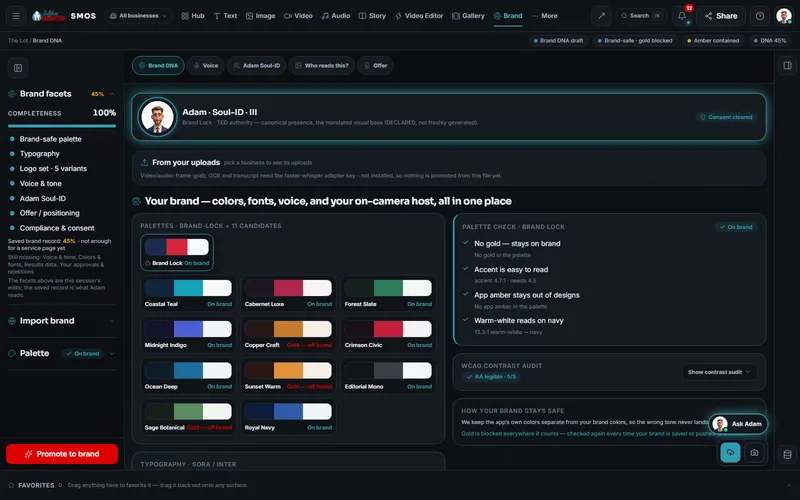
No sales hype and no keyword lists. It should match your website word for word on the facts. In the OS, the file is written from your Brand DNA, the same facts that feed your website and listings, so it never says something your site doesn't.
What it isn't
It isn't a switch that turns on AI answers. Google says there are "no additional requirements" and no special schema to appear in AI Overviews or AI Mode. The basics matter: pages Google can crawl, internal links, real text, a good page experience, and structured data that matches what's on the page (Google Search Central).
So treat llms.txt like a tidy label on a box. Helpful. Not the contents.
What actually gets you named
Here's what the research points to for local businesses:
- Your Google Business Profile. It's about 28.6% of all citations in local AI answers, the #1 source (BrightLocal, Aug 2026).
- Yelp. It appears in about 80% of ChatGPT local answers (BrightLocal, Aug 2026).
- Your industry's directories. Angi was about 7.0% of AI citations in home-services prompts, and Zocdoc 5.5% and Healthgrades 4.5% in healthcare (5W, Q1 2026).
- Fresh reviews. 82% of consumers read AI-written review summaries (BrightLocal LCRS 2026), and those summaries are built from your reviews.
- Pages that answer questions. A short answer first, then the detail, under a heading shaped like the question.
How we build for AI answers
In the OS, AI Answers is the part of SEO & AI Search that does this work:
- Answer-first writing. Each answer leads with 40–45 words or less, cites a fact and names your business.
- Schema (the labels search engines read): FAQ, HowTo and Speakable blocks that match the visible text.
- llms.txt, published with your site.
- Your business in 4 rings: your core facts, your content, your listings (Google, Apple, Bing, Wikidata), and what others say about you (Reddit, YouTube, reporter quotes, best-of lists).
- Tracking: your share of AI answers per engine, with the real links each one cites, and which AI crawlers visit your site, read for free from your server logs.
- Corrections: when an engine states a wrong fact about you, a correction is staged for you to approve.
Published studies show some things lift how often AI tools cite a page, like adding a stat, a quote or a named source. We show those as a direction, never a promise.
Should you add it today?
If we build your site, it's part of the build. If not, here's the honest order:
- Fix your Google profile and your Yelp listing first.
- Make your name, address and phone match everywhere.
- Add short answers to the top of your service pages.
- Ask for reviews every week.
- Then add llms.txt. It takes less time than any step above.
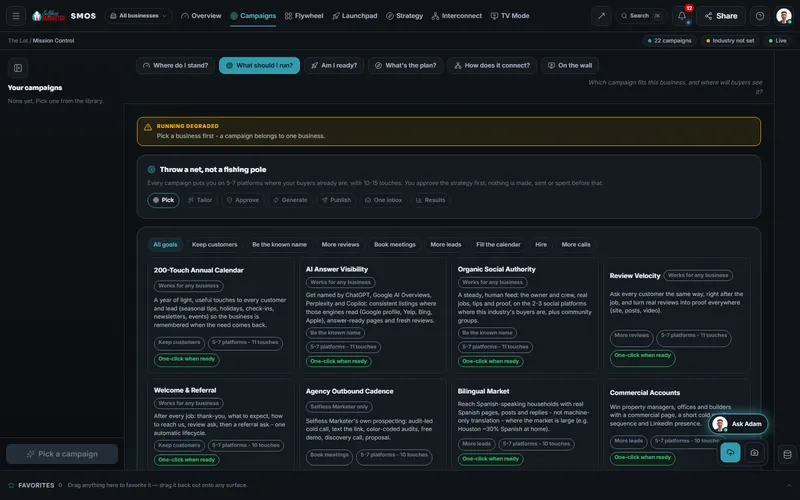
Want to see what AI tools say about you now? The AI search section of the Free Audit checks. The longer read is How to show up in ChatGPT and AI answers, and the AI Answer Visibility campaign is the 30-day plan.
Quick answers
Questions owners ask
Is llms.txt the same as robots.txt?
No. robots.txt tells crawlers where they may and may not go. llms.txt is a plain-words summary of your business and your most useful pages.
Will llms.txt get me into ChatGPT's answers?
Nobody can promise that. It helps AI tools understand you, but your Google profile, Yelp, reviews and answer-ready pages carry far more weight.
How often should it change?
Whenever your facts change: a new service, a new area, new hours. In the OS it's drawn from your Brand DNA, so it updates with everything else.
Keep going
Related pages
Free Audit
See what's costing you customers.
Ten sections, color-coded. The areas in red are the gaps and errors costing you visibility, and therefore, customers. About 60 seconds.

YOUR TEAM runs it with the OS, or OUR TEAM runs it for you with Done-For-You. Not sure? Which one fits me?