


Guide · Mission Control
Do you have a bit of a Frankenstein setup?
Twelve logins, four invoices, and nobody talks to anybody. What it really costs, and 7 steps to move to one place without losing a single lead. In the OS, the fix lives in Mission Control.
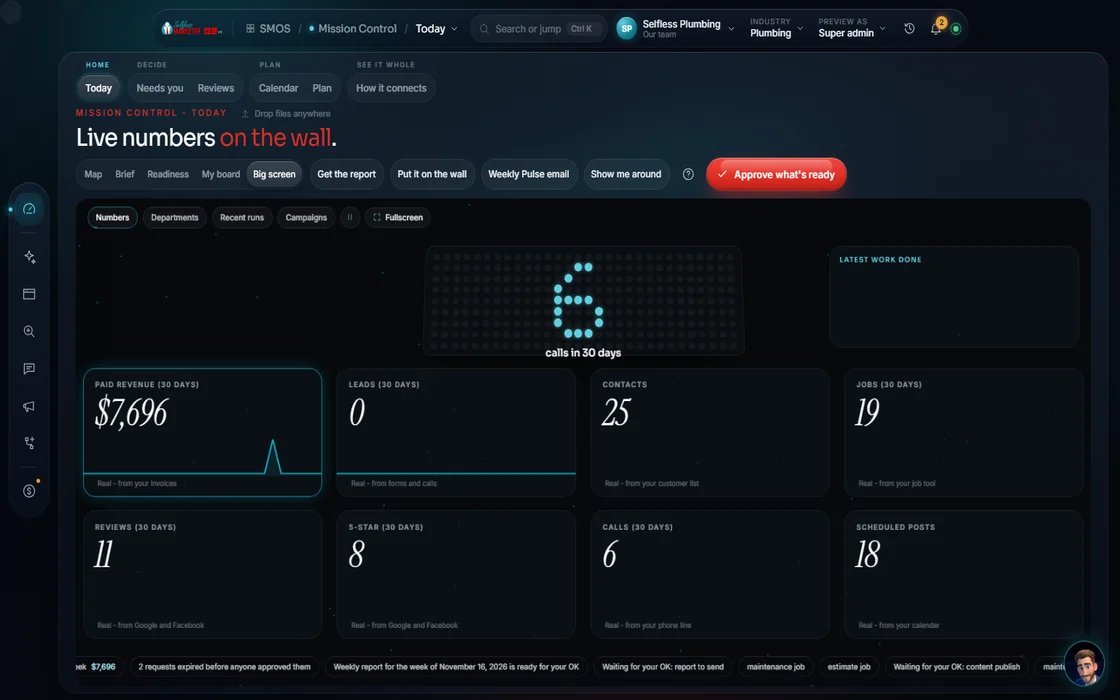 demo business
Do you have a bit of a Frankenstein setup?
One company does your website. Another does SEO. Somebody else does social. A freelancer does content. You pay for a review tool, a texting app, a scheduler, a CRM and a call tracker. Twelve logins, four invoices, and nobody talks to anybody.
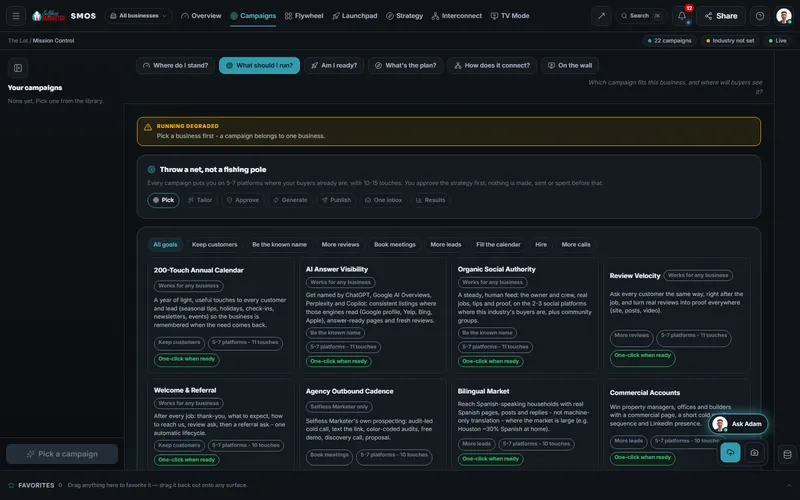
That's a Frankenstein setup. Pieces sewn together from different places, and it shows. Your brand looks different on every platform. When leads drop, every vendor points at another vendor. And you're the one stuck holding it together. This guide shows how to take it apart without losing a single lead. In the OS, the fix lives in Mission Control: one place over everything.
What it really costs you
The money is the part you can see. Here's what a Frankenstein stack typically runs, from published prices and dated third-party trackers (October 2026), as Estimates:
- Lean, do it yourself with 7-9 tools: $400-$800 a month, plus 20-40 of your own hours a month, and still no SEO, no ad management and no one running it.
- Typical, 10-14 tools plus a freelancer or two: $1,500-$4,000 a month, plus $3,000-$15,000 up front, and 4-12 weeks before anything is live.
- Agency, retainers for web, SEO, social and ads: $4,000-$12,000 a month in fees before ad spend, $10,000-$60,000 up front, and 12-24-month contracts.
One of each tool at the cheapest reasonable tier, with no agency at all, comes to roughly $1,900-$3,000 a month across 15-20 logins (Estimate). Most businesses pay closer to $1,000 per service, rather than total.
The costs you can't see are bigger: a brand that isn't consistent anywhere, leads that fall between two vendors, and your own hours spent chasing people who should be chasing you.
Step 1: List every vendor and every login
Open your bank statement and your email. Write down every marketing tool and service you pay for, what it costs a month, what it does, and who has the login. Include the free ones. You may find a few you forgot you were paying for.
A simple table works. One row per tool or vendor, with these columns:
- What it's called
- What job it does
- What it costs a month (and any setup fee you paid)
- Whose name and email own the account
- The contract end date and the notice it needs
- What you'd lose if it stopped tomorrow
That last column is the one that tells you what to protect first.
Step 2: Find the overlaps and the gaps
Next to each item, write which job it does: website, social, SEO, ads, content, reviews, phones, follow-up, scheduling, CRM. You'll find jobs you pay for twice (two schedulers, two review tools) and jobs nobody does at all (no follow-up, no one answering after hours). The gaps cost more than the overlaps.
Step 3: Find out who owns what
This is the step that saves people. For each piece, ask: whose name is on it?
- Your domain name
- Your website and its files
- Your Google Business Profile
- Your ad accounts (Google, Facebook, others)
- Your social media pages
- Your customer list and your data
Every one should be in your name, with you as the owner or top admin. If a vendor owns your domain or your ad account, get it moved to you now, while you're on good terms. With us, you own all the work.
Step 4: Read the contracts
Find the renewal date, the cancellation terms and the notice period for every contract. Some renew automatically for a full year. Some need written notice weeks ahead. Put every date on your calendar. Don't let a renewal decide for you.
Step 5: Pick one source of truth for your brand
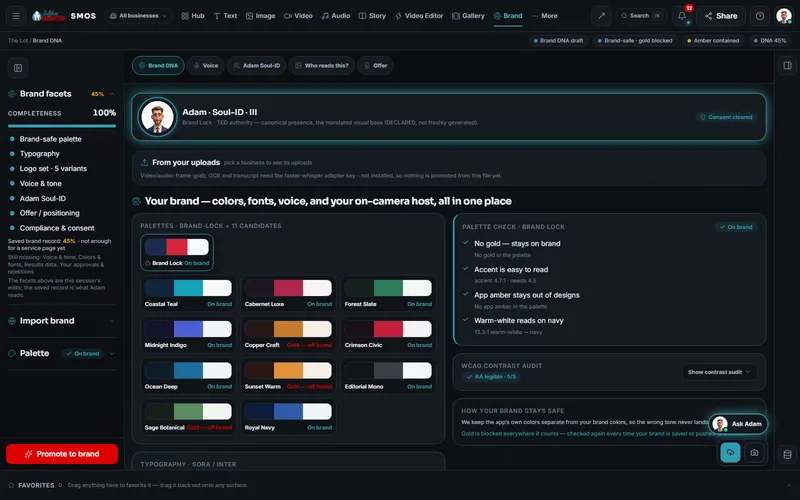
Before you move anything, write down your brand in one place: your logo, your colors, your fonts, how you talk, your offers, your service area and your phone number. Every page, post, ad and reply should come from this one sheet. In the OS, that's Brand DNA, and it feeds every department.
Step 6: Move in order, one service at a time
Don't move everything in one weekend. Move like an assembly line, one service at a time, and make sure each one works before the next:
- Website first, because everything else points to it.
- Social next, from one calendar.
- SEO, built on the site and your Google profile.
- Paid Ads, once tracking is in place.
- Content, made once and used everywhere.
- AI Automation, the follow-up, texting, reviews and back office.
Step 7: Cancel last
Never cancel the old tool until the new one is live and tested. Run them side by side for a short overlap if you need to. Export your data (contacts, reviews, reports) before you cancel anything.
Don't lose what you've built
Switching should never cost you what already works. Protect these:
- Keep your phone number. It's on your trucks, your cards and every listing.
- Keep your domain name. If the website moves, the address stays the same.
- Keep your Google Business Profile. Your reviews live there. Change who manages it, never start a new one.
- Point old page addresses to new ones. If a page moves, set up a redirect so search engines and old links still find it.
- Export everything first: contacts, customer history, reviews, reports and photos.
Before you switch, ask yourself 3 things
- What do I want to stop doing myself? If the answer is "most of it," you want a team, not more software.
- What do I want to keep doing? Some owners love posting their own videos. Keep what you love; hand off the rest.
- How will I know it's better? Pick 3 numbers now (calls a week, new reviews a month, booked jobs from online) and write down today's count. Check them again in 90 days.
What you get back
The point of one place isn't a lower bill, though it often is one. It's what you get back. Your hours, first: no more logging into 12 tools to piece together a week. A brand that looks the same on every page, post and ad. One person to call when something's wrong. And the numbers in one place, so you can finally see which part of your marketing pays and which part just costs.
What one place looks like
Everything online is connected, in the era of algorithms. So it should be managed that way: 1 place, 1 team, 1 flat rate. In the Selfless Marketer OS, Mission Control answers "where do I stand?" across your whole business. The Command Graph shows how every piece connects: one change, every department knows. There's one inbox, one calendar and one approvals queue, and nothing goes out until you approve it.
The OS is $997 a month (first month $497), with every department included and nothing bought separately. Or let our experts handle everything with Done-For-You: $2,497 or $4,997 a month, the OS included, $500 a month of ad spend included on the $4,997 tier, and your own project manager. Price out your own stack with the tool-stack cost calculator.
What you pay today
Three Frankenstein stacks, priced
Do it yourself with 7–9 tools. No setup fees, 20–40 of your hours a month, and still no SEO, no ads management, no one running it.
10–14 tools plus a freelancer or two, plus $3,000–$15,000 up front, 4–12 weeks before anything is live.
Retainers for web, SEO, social and ads, before ad spend. $10,000–$60,000 up front, 12–24-month contracts.
Published prices and dated price trackers, October 2026. Estimate
How the numbers on this page are labeled: outside stats and prices name their source in the sentence. Counts and rules about the OS are Product facts (what the software does or has). Past client results are Real, documented, and results vary. Where we say "in our experience," that's our view from years of doing this, not a study. Nobody can honestly promise you a ranking, and we don't.
Keep going
Related pages
Next step
Let's figure out where you are, and where you want to be.
A Free Strategy Session, 30 minutes, with a real person. We check your territory, show you exactly what's costing you customers and map out your plan. No pressure. No hard sell. No catch.

YOUR TEAM runs it with the OS, or OUR TEAM runs it for you with Done-For-You. Not sure? Which one fits me?