


Dental websites
What should a dental website include?
Easy booking, plain talk about cost and insurance, and proof you're kind and real, all on a phone.
A dental website should make booking easy, explain insurance and cost in plain words, and prove your practice is kind, clean and real, all on a phone. Behind the page, every request should land on your front desk's list, so no patient falls through the cracks.
Most dental sites look fine and still lose patients. Here's what to include, and why.
1. Booking, front and center
A dental site's main job is a booked visit. Pick 1 main action and make it the biggest button on every page: "Book an appointment" or "Claim your new-patient visit." Keep the phone number tappable, too.
The 3 website templates we match to dental practices all start there:
- Calm Clinic: open booking slots right at the top of the page.
- New Patient Welcome: an offer card for the first visit.
- Same-Day Urgent Clinic: a call button first, for the cracked tooth on a Saturday.
2. Insurance and cost, in plain words
People put off the dentist because they're worried about the bill. Say which plans you take, how you check benefits, and what a first visit includes. A headline our system writes for dental: "We Verify Your Benefits Before You Sit Down." (Sample: written by the OS from the dental playbook, not a client.)
Give insurance its own page. Give each big service, like implants and clear aligners, its own page that explains the steps, the timeline and how financing works.
3. A page for every service
Cleanings, exams, fillings, crowns, implants, aligners, whitening, emergency care, kids' dentistry: each gets its own page. A patient searching "dental implants near me" should land on your implants page, not your home page. Each page answers common questions first, in short, plain sentences, so Google, and the AI tools people now ask, can quote you.
4. Real reviews, recent ones
Reviews do a lot of the selling before anyone calls. In 2026, 97% of consumers read reviews for local businesses, 74% look for reviews from the last 3 months, and 47% won't use a business with fewer than 20 reviews (BrightLocal LCRS 2026). Show a live, dated review wall with your replies.
Never pick only the 5-star ones. Google's review policy forbids asking only happy patients, and the FTC's 2024 rule bars hiding the bad reviews while implying you show them all.
For dentists, Yelp made up 15.4% of the citations in local AI answers (BrightLocal, Aug 2026), so keep your Yelp profile as complete as your Google one.
5. Real people, real rooms
Show your actual team and your actual office. Patients want to know who'll be in the room. Use before-and-after photos only with written patient consent, and say so. Medical claims need the right disclaimers for your state.
6. Fast, readable and accessible
- Fast: Google's "good" marks are LCP of 2.5 seconds or less, INP of 200 milliseconds or less, and CLS of 0.1 or less on phones (web.dev).
- Readable: in Unbounce's 2024 data for professional services, pages written at a 5th–7th grade level converted at 12.9%, against 6.6% at 8th–9th grade.
- Accessible: 95.9% of the top 1 million home pages have detected accessibility failures, most often low-contrast text (WebAIM Million 2026). Fix it in the site itself; overlay widgets aren't a fix.
7. Every form is a lead, not an email
This is where most dental sites leak. A "request an appointment" form that emails a shared inbox gets missed on busy days. On a site built in our Website department, every form becomes a contact in your CRM, lands in one inbox with your calls and texts, and starts a follow-up that ends on STOP. Online booking shows real open slots, live once your calendar is connected.
8. The listings that point back to it
Your site is the hub. The spokes for dental are Google, ChatGPT, Yelp, Zocdoc, Healthgrades, your insurance networks' provider directories and Facebook. Zocdoc was 5.5% and Healthgrades 4.5% of AI citations in a 2026 study (5W, Q1 2026). Keep your name, address and phone the same on every one.
How we build it
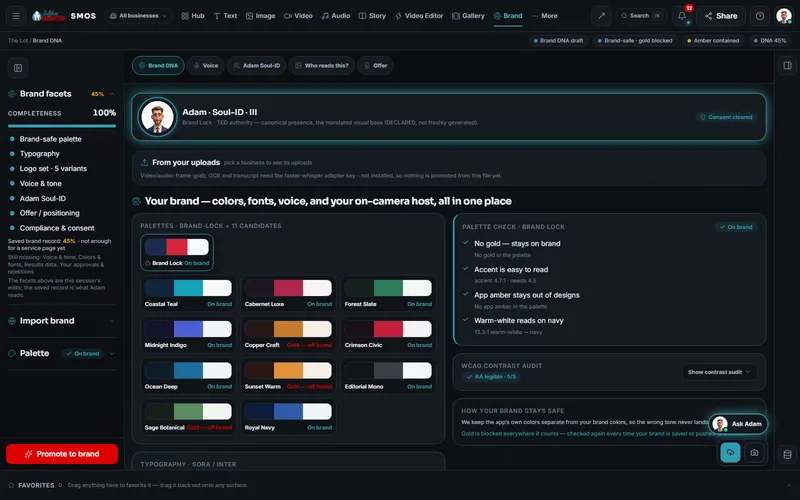
In the OS, your assistant builds the site from your Brand DNA: your services, your area, your look, your words. A 24-point launch check looks for filler text, weak contrast and broken buttons before anything goes live, and drafts never touch your live site. Want to see a full working site first? Our live demos include a 54+ page plumbing site with an owner admin, a customer portal and a technician app. Different trade, same build.
More on what every local site needs: What a local business website needs in 2026. Or start with the website section of the Free Audit.
Quick answers
Questions owners ask
Should my dental site have online booking?
Yes. Booking is built into the OS, with real open slots. It goes live once your calendar is connected.
Can the site be in Spanish too?
Yes. Our Bilingual Community template uses full Spanish pages, each checked by a fluent speaker, not a translate button.
Do I own the website?
Yes. You own all the work.
Keep going
Related pages
Free Audit
See what's costing you customers.
Ten sections, color-coded. The areas in red are the gaps and errors costing you visibility, and therefore, customers. About 60 seconds.

YOUR TEAM runs it with the OS, or OUR TEAM runs it for you with Done-For-You. Not sure? Which one fits me?